
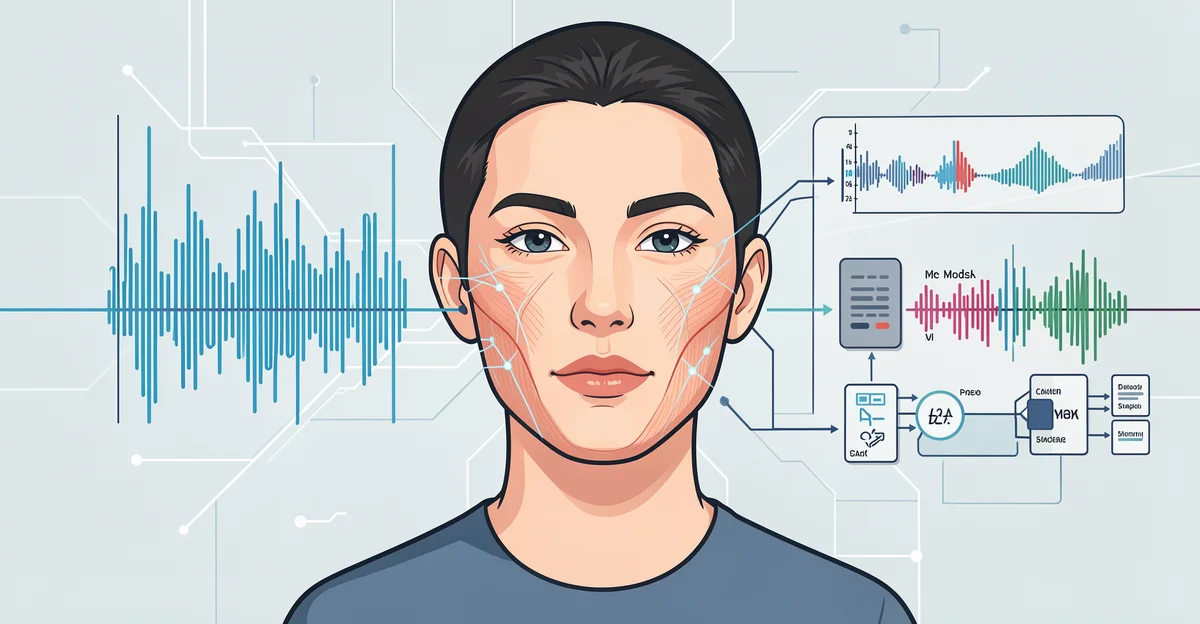
Have you ever watched a video where the character’s lips move in perfect harmony with every word—even when the audio was recorded in another language? That seamless effect is the result of AI-powered lip synchronization, a technology that uses deep learning to analyze speech sounds and map them to precise mouth movements. It’s no longer just a Hollywood trick; it’s becoming a practical tool for creators, educators, and businesses worldwide.
In this article, we’ll break down the core components of AI-powered lip synchronization, from audio feature extraction to facial rendering. You’ll learn how these systems work, what makes them accurate, and how you can start using them in your own projects. Let’s dive in.
Introduction
AI-powered lip synchronization is the process of automatically aligning a person’s mouth movements in a video with a target audio track. The goal is to make it look as though the speaker actually said the words in the new audio, even if the original recording was in a different language, had different timing, or never existed at all. This article explores the technology behind AI-powered lip synchronization with clear, practical guidance, so you can understand how these systems work, where they are useful, and what limits they still have.
Key Concepts
At a high level, AI lip synchronization combines computer vision, speech processing, and generative modeling. The system must answer one question repeatedly: given this audio frame and this video frame, what should the mouth look like right now?
Audio representation
Modern systems usually convert audio into short feature vectors. Instead of working with raw waveforms, they use mel-frequency cepstral coefficients, spectrograms, or learned audio embeddings. These representations capture phonetic content, such as whether the speaker is making a “b” or an “f” sound, which directly affects lip shape.
Visual representation
On the video side, the system detects the face, aligns it, and crops the mouth region. It then encodes those pixels into a latent representation. Some pipelines also track facial landmarks to preserve head pose and jaw motion.
Alignment and generation
The core model learns a mapping from audio features to mouth shapes. Early systems used recurrent networks, while current systems often use transformers, diffusion models, or GANs. The output is a sequence of synthesized mouth frames that are blended back into the original video.
Sync evaluation
Quality is measured in two ways: visual realism and audio-visual sync. Common metrics include LSE-D and LSE-C, which estimate how well the generated mouth matches the speech, plus human preference tests.
Deep Dive
Understanding the fundamentals of AI-powered lip synchronization helps you make informed decisions. Behind the scenes, most pipelines follow a similar architecture. First, a preprocessing stage detects the face and normalizes it. Second, an audio encoder extracts speech features. Third, a cross-modal model fuses audio and video into a shared space. Fourth, a generator produces the new mouth region. Fifth, a post-processing stage blends the result, corrects color, and restores sharpness.
Two families of models dominate. GAN-based methods are fast and can run in real time on consumer GPUs. Diffusion-based methods produce more stable and realistic results but require more compute. Hybrid approaches use a GAN for speed and a refiner for quality.
Identity preservation is a major challenge. The model must change the mouth without altering the speaker’s identity, skin tone, or background. This is often handled with identity encoders, face restoration networks, and careful masking. Temporal consistency is another challenge. Shot-by-shot generation can flicker, so many systems process short windows of frames and enforce smoothness between them.
Latency matters in live applications such as video calls or virtual avatars. To hit real-time performance, engineers use model quantization, pruning, and frame caching. For offline dubbing, quality is prioritized over speed.
Best Practices
Reliable information and consistent habits lead to better long-term outcomes. Whether you are evaluating a tool or building your own system, these practices reduce risk and improve results.
- Start with clean audio. Remove background noise, normalize volume, and match sample rates before feeding data into the model.
- Use high-quality source video. Good lighting, a clear face angle, and minimal motion blur make the output much more convincing.
- Keep the face frontal when possible. Extreme side angles or heavy occlusion reduce accuracy.
- Test with diverse speakers. Accents, speaking rates, and facial hair can affect performance.
- Check sync, not just realism. A mouth can look natural but still be mistimed.
- Respect consent and disclosure. If you alter someone’s speech, make that clear and follow applicable laws.
- Monitor for bias. Some models perform worse on certain skin tones or age groups, so validate across demographics.
Step-by-Step Guide

Step 1: Understand the fundamentals
Learn what lip synchronization actually does. It maps audio phonemes to visual mouth shapes, then generates new frames. Knowing this helps you separate marketing claims from technical reality and ask the right questions about accuracy, latency, and data handling.
Step 2: Assess your starting point
Look at your source material. Do you have a clear, well-lit video and a clean audio track? Are you working offline or in real time? Check your hardware, since diffusion models may need a strong GPU while simpler tools can run on a laptop.

Step 3: Set clear goals
Decide what success looks like. For a dubbed film, natural mouth shapes and perfect sync matter most. For a live avatar, low latency matters more than photorealistic detail. Write down your target resolution, acceptable delay, and quality threshold.

Step 4: Gather necessary resources
Collect a clean audio file, a stable video clip, and any reference images of the speaker. You will also need software: open-source libraries such as Wav2Lip, SadTalker, or commercial APIs. If you are building a pipeline, prepare a GPU, a labeled test set, and an evaluation script.

Step 5: Apply the core methods
Run the preprocessing step to detect and align the face. Extract audio features. Feed both into the model to generate mouth frames. Blend the output back into the original video. Then review the result frame by frame. Adjust the model, the audio timing, or the mask until the sync and realism meet your goals.
FAQ
What should I know about The Technology Behind AI-Powered Lip Synchronization?
You should know that it combines audio processing, face detection, and generative AI. It is not magic; it depends on clean inputs and a model trained on large datasets. Quality varies by speaker, language, and video conditions, so always test before relying on it for important work.
Who is this guide for?
This guide is for content creators, video editors, developers, and anyone curious about how AI lip sync works. It assumes no deep machine learning background but gives enough technical detail to help you choose tools, set expectations, and avoid common mistakes.
Conclusion
AI-powered lip synchronization is a fast-moving field built on speech features, face modeling, and generative networks. By understanding the pipeline, evaluating your inputs, and following consistent testing habits, you can use this technology more effectively. Whether you are dubbing a video, building an avatar, or just learning, the key is to match the tool to the task and verify the result before you publish.
Frequently Asked Questions
What should I know about The Technology Behind AI-Powered Lip Synchronization?
This guide covers the essentials of The Technology Behind AI-Powered Lip Synchronization with practical steps you can apply right away.
Who is this guide for?
Anyone looking for a clear, structured overview without unnecessary complexity.
You now have a solid foundation for The Technology Behind AI-Powered Lip Synchronization. Apply the best practices above and revisit this guide as your needs evolve.